
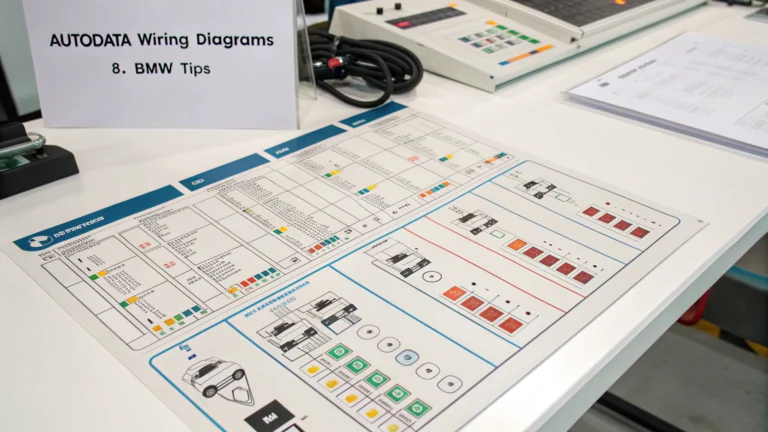
Introduction
BMW vehicles are renowned for their advanced electrical architecture and cutting-edge technologies. Mechanics and automotive technicians consistently encounter complexities while diagnosing electrical issues within BMW models, making clear, accurate wiring diagrams indispensable. When troubleshooting BMW electrical systems, professionals rely heavily on trusted resources, making Autodata BMW wiring diagrams a crucial component in their diagnostic toolbox. However, even experienced technicians sometimes find these diagrams challenging, particularly if unfamiliar with BMW’s unique conventions.
At AutoFixData.com, our goal is to simplify your diagnostic process. With reliable access to diagnostic solutions from industry-leading platforms like AllData, AutoData, and HaynesPro, we help you quickly identify and solve automotive electrical problems accurately. In this post, we’ll dive deep into Autodata BMW wiring diagrams and arm you with eight expertly curated strategies to effectively navigate, interpret, and apply these data resources.
Table of contents
- Introduction
- Problem Identification
- Technical Background
- Solution Overview
- Step-by-Step Process: Tips for Using Autodata BMW Wiring Diagrams
- Tip 1: Verify VIN and Vehicle Model Accurately
- Tip 2: Understand BMW-Specific Terminology and Abbreviations
- Tip 3: Pay Close Attention to BMW Wire Color Coding
- Tip 4: Identify and Verify Component Locations Before Testing
- Tip 5: Follow BMW’s Module-Based Diagnostic Path
- Tip 6: Leverage Connector and Junction Identification Features
- Tip 7: Interpret CAN and LIN Bus Networks Correctly
- Tip 8: Utilize Diagnostic Flowcharts Provided by Autodata
- Common Mistakes to Avoid
- Advanced Techniques
- Tools and Resources Needed
- Real-World Application
- Conclusion
- FAQs
- Q1. Can Autodata BMW wiring diagrams help diagnose intermittent electrical problems?
- Q2. Are Autodata BMW wiring diagrams updated regularly?
- Q3. Do Autodata diagrams include BMW-specific fault codes?
- Q4. Can DIY enthusiasts safely follow Autodata BMW wiring diagrams?
- Q5. Is a specialized scan tool required to go along with Autodata BMW wiring diagrams?
Problem Identification
BMW models have notoriously intricate electrical systems. According to automotive industry data, approximately 45–50 percent of BMW diagnostic challenges encountered by mechanics today revolve around electrical system failures, intermittent faults, and component misinterpretations. Wiring diagrams provided by platforms such as Autodata often contain brand-specific symbols, abbreviations, and color-coding schemes that can bewilder technicians unfamiliar with BMW conventions.
Misinterpretation of Autodata BMW wiring diagrams can lead to costly diagnostic errors, wasted hours, or even expensive component replacements that fail to solve the root issue. Therefore, mechanics must acquire undisputed expertise to accurately interpret and utilize these diagrams effectively.
Technical Background
Understanding the basics of BMW electrical systems sets the foundation for accurate diagnostics. BMW wiring diagrams differ slightly from more generalized automotive diagrams in these essential ways:
- Specific BMW symbols and component representations used in conjunction with unique European-standard diagrams.
- Proprietary abbreviations and German-based synonyms for certain components or systems.
- Specialized concepts such as CAN (Controller Area Network) bus systems, MOST (Media Oriented Systems Transport), and LIN (Local Interconnect Network) bus.
- Specific BMW wire color codes and harness routing schemes.
Because BMW models incorporate complex networks involving various control modules, sensors, actuators, and harnesses integrated into multiple linked subsystems, correct reading of wiring diagrams becomes pivotal to successful diagnostics.
Solution Overview
Diagnostic platforms like Autodata, AllData, and HaynesPro, all accessible via AutoFixData.com, provide detailed wiring diagrams specifically tailored for BMW vehicles. Here’s how these diagnostic solutions simplify the troubleshooting process:
- Clear representation of wires, connectors, junctions, and ground points.
- Detailed component locations, connector pin numbers, and specific electronic control module integration.
- Recommended procedures for tracing, testing, and pinpointing component faults.
- Regular updates that reflect accurate technical information for newer BMW models.
Platforms hosted by AutoFixData ensure rapid diagnostic access, enabling garage owners, mechanics, and enthusiasts to efficiently analyze electrical issues within BMW vehicles accurately and quickly.
Step-by-Step Process: Tips for Using Autodata BMW Wiring Diagrams
Tip 1: Verify VIN and Vehicle Model Accurately
To precisely interpret Autodata BMW wiring diagrams, ensure you correctly input the vehicle’s VIN, model, and engine information. BMW vehicles frequently have mid-year wiring updates. Incorrect model identification can lead to misinterpretations and diagnostic errors.
Tip 2: Understand BMW-Specific Terminology and Abbreviations
Autodata BMW wiring diagrams contain symbols and abbreviations often derived from German terminology. Familiarizing yourself with BMW-specific abbreviations (e.g., DME for Digital Motor Electronics, ZGM for Central Gateway Module) is crucial.
Tip 3: Pay Close Attention to BMW Wire Color Coding
BMW employs specific wire color codes—solid and tracer wires—unique to their brand. Always cross-reference harness colors shown in Autodata diagrams with the physical wires you inspect during diagnostics.
Tip 4: Identify and Verify Component Locations Before Testing
Use Autodata to locate precise component positions before testing. BMW designs frequently integrate multiple modules and sensors in tight spaces, and locating these accurately prevents unnecessary disassembly.
Tip 5: Follow BMW’s Module-Based Diagnostic Path
BMW diagrams highlight module-based troubleshooting practices. Always start diagnosis at the controlling module, using the wiring diagrams to strategically pinpoint connector numbers and pin designations.
Tip 6: Leverage Connector and Junction Identification Features
BMW uses numerous multi-pin connectors. Pay special attention to connector pin numbers and positional indicators. Autodata graphics often highlight exact positions, making harness verification straightforward.
Tip 7: Interpret CAN and LIN Bus Networks Correctly
BMW integrates multiple communication networks (CAN, LIN, FlexRay). Identify the correct network representation within Autodata diagrams—misinterpretation could lead directly to diagnostic misdirection.
Tip 8: Utilize Diagnostic Flowcharts Provided by Autodata
Do not overlook Autodata’s built-in diagnostic flowcharts, which correspond with provided wiring diagrams. Such flowcharts can break down complicated diagnostic scenarios into concise action steps, dramatically improving your diagnostic speed and accuracy.
Common Mistakes to Avoid
- Ignoring Color-Coding Schemes: Incorrect wire identification occurs frequently when mechanics rush or skip BMW’s standard wiring color codes indicated in Autodata diagrams.
- Misidentifying Component Abbreviations: Misinterpreting BMW-specific terminology or abbreviations can lead to troubleshooting the wrong component entirely.
- Not Confirming Connector Orientation: Incorrectly assuming connector orientation without meticulous Autodata diagram reviews creates unnecessary confusion and repeat diagnostics.
Advanced Techniques
To achieve advanced-level diagnostics of BMW electrical systems using Autodata diagrams, professionals incorporate additional sophisticated techniques:
- Oscilloscope Trace Verification: Technicians use an oscilloscope alongside diagrams to verify waveforms, pinpoint intermittent faults accurately, and confirm digital network communication.
- Voltage Drop Testing: Experienced mechanics utilize Autodata diagrams to methodically isolate circuit segments and perform precise voltage drop tests to identify faulty harness segments.
- CAN Bus Decoder Tools: Advanced mechanics deploy CAN bus decoding tools, using Autodata diagrams for reference, rapidly isolating problematic modules or data transmission issues.
Tools and Resources Needed
Here’s a recommended list of tools and diagnostic resources every BMW mechanic should have when applying Autodata BMW wiring information:
- BMW-compatible OBD-II diagnostic scan tools
- Digital multimeter (preferably automotive-grade)
- Automotive oscilloscope for advanced waveform analysis
- Circuit probe/power probe tester
- CAN bus analyzer tool (for advanced CAN issues)
- Reliable industry-approved resource access via AutoFixData (Autodata/AllData/HaynesPro)
Real-World Application
Consider this common BMW case study: a customer brings in their 2016 BMW 328i complaining of sporadic ABS and traction control lights illuminating intermittently. The mechanic uses AutoFixData to quickly access Autodata BMW wiring diagrams, pinpointing potential wiring connectors related to the ABS sensor circuits on rear wheel sensors. After carefully verifying Autodata information regarding wire colors, connector pin designations, and component locations, the technician discovers a compromised wire at the rear-left wheel sensor harness. The problem is swiftly repaired, saving diagnostic guesswork, customer downtime, and unnecessary component replacement costs.
Conclusion
Mastering Autodata BMW wiring diagrams is essential for any technician working regularly on BMW vehicles. Following these eight BMW-specific wiring diagram interpretation tips ensures accurate diagnostics, fewer missteps, and enhanced productivity. With AutoFixData’s seamless access to premier diagnostic platforms like Autodata, AllData, and HaynesPro, automotive professionals gain unparalleled confidence and efficiency in their diagnostic procedures. Ready to streamline your diagnostic processes and increase profitability? Discover how AutoFixData simplifies your access to Autodata BMW wiring diagrams and more:
FAQs
Q1. Can Autodata BMW wiring diagrams help diagnose intermittent electrical problems?
Absolutely. By detailing connector locations, wire color codes, fuse boxes, and module integration, Autodata wiring diagrams from AutoFixData allow quick identification and isolation of intermittent electrical problems.
Q2. Are Autodata BMW wiring diagrams updated regularly?
Yes, Autodata regularly updates their BMW diagrams. AutoFixData ensures your diagnostic information is consistently current, reflecting the latest manufacturer changes.
Q3. Do Autodata diagrams include BMW-specific fault codes?
Yes. Utilizing Autodata via AutoFixData provides easy reference to BMW-specific fault codes, helping match wiring diagrams with precise diagnostic trouble codes.
Q4. Can DIY enthusiasts safely follow Autodata BMW wiring diagrams?
Adequate automotive knowledge, basic electrical training, and familiarity with safety practices are recommended. For complex BMW systems diagnostics, obtaining professional assistance or referencing diagnostic resources from AutoFixData is advisable.
Q5. Is a specialized scan tool required to go along with Autodata BMW wiring diagrams?
While an OBD-II scanner can suffice for basic code reading, a BMW-compatible scan tool with advanced diagnostic capabilities complements Autodata diagrams, significantly improving diagnostic outcomes.


