
Introduction
One of the most common challenges automotive mechanics face when troubleshooting complex electrical issues is accessing reliable, accurate, and easy-to-understand wiring diagrams. Inefficient and unclear diagrams can turn simple diagnostic tasks into hours-long nightmares filled with guesswork. If you’ve ever struggled to accurately trace wires, spot continuity problems, or verify electrical components in modern vehicles, you know this difficulty firsthand. This is precisely where Autodata outperforms alternative solutions. In this detailed exploration of Autodata vs competitors, you’ll discover why Autodata wiring diagrams are considered essential by professional mechanics worldwide—available easily through trusted platforms like AutoFixData.
Table of contents
- Introduction
- Problem Identification
- Technical Background
- Solution Overview
- 3 Reasons Why Autodata Wiring Diagrams Are Superior to Competitors
- Step-by-Step Process For Diagnosing Electrical Problems Using Autodata Diagrams
- Common Mistakes to Avoid
- Advanced Techniques
- Tools and Resources Needed
- Real-World Application – Case Study
- Conclusion
- FAQs
Problem Identification
Today’s vehicles no longer run on simple circuits with limited electrical components. Advanced automotive technologies—including CAN-bus networks, infotainment systems, electronic control units (ECUs), and complex sensor arrays—have exponentially complicated wiring setups. According to industry studies, technicians spend approximately 40-50% of repair time on vehicle diagnostics related directly to electrical systems. What’s worse, outdated or unclear wiring diagrams add hours of wasted effort, inaccurate diagnostics, and costly delays in service delivery.
Common wiring diagram challenges mechanics face include:
- Confusing, poorly labeled diagrams leading to misdiagnoses.
- Inconsistent color schemes across different vehicle models and manufacturers.
- Lack of precise connector, splice, junction, or ground-point details.
- Absence of integrated OEM references and standardized symbols.
Understanding these concerns highlights why selecting the best wiring diagrams is central to efficient, profitable, and accurate automotive repairs: Exactly where the Autodata vs competitors debate clearly favors Autodata.
Technical Background
To effectively diagnose automotive electrical faults, mechanics must rely heavily on accurate wiring diagrams. These visual diagrams, detailed schematics indicating each wire’s route along with component connections, enable technicians to identify:
- Wire locations and color coding.
- Connector pin-out details.
- Relay and fuse configurations.
- System-specific grounds and power distribution points.
- Communication networks (CAN, LIN bus) and their associated readings.
High-quality diagrams are vital for timely diagnosis and repair, helping technicians quickly pinpoint problems, perform continuity inspections, voltage-drop tests, and elaborate harness examinations. Their accuracy, clarity, and ease-of-use directly influence diagnostic speed, customer satisfaction, and workshop profitability.
Solution Overview
When evaluating Autodata vs competitors like AllData or HaynesPro, professional mechanics often find Autodata’s wiring diagrams superior due to their level of precision, logical layout, and real-world usability. Accessible through AutoFixData’s innovative diagnostic platform offering, these diagrams assist mechanics and garage owners alike, delivering unmatched troubleshooting clarity.
Autodata wiring diagrams consistently provide:
- Clear, standardized symbology aligned with OEM specifications.
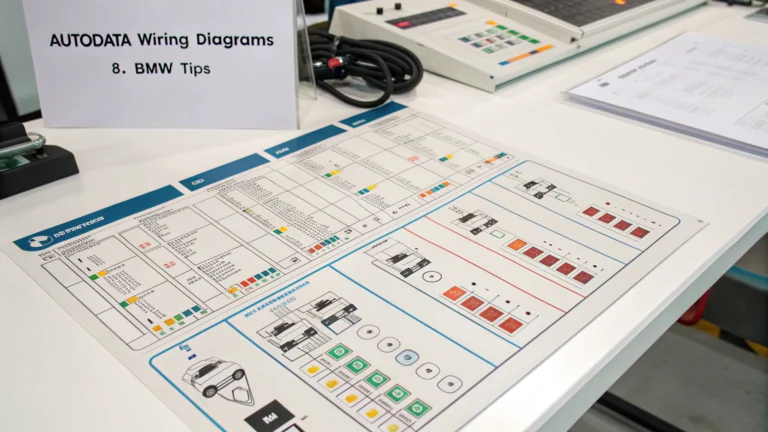
- Detailed circuit representation with realistic component visuals.
- Interactive interfaces with intuitive zoom and navigation capabilities.
- Direct integration with OEM repair times, component locations, wiring colors, and connector visuals.
Through AutoFixData’s access to Autodata diagrams, mechanics perform diagnostics with greater precision and efficiency, boosting productivity significantly.
3 Reasons Why Autodata Wiring Diagrams Are Superior to Competitors
Reason #1 – Enhanced Detail and Accuracy
In comparing Autodata vs competitors, technicians immediately notice Autodata’s attention to details often missing with alternative sources. Autodata leverages carefully sourced OEM data to ensure diagrams match factory standards, allowing mechanics to trust diagram integrity.
- Precise OEM wire colors, connectors, and splice points clearly marked.
- Comprehensive ground and power source references simplify circuit tracking.
- Clearly annotated voltage values, fuse and relay positions at a glance.
Reason #2 – User-Friendly Format and Navigation
Unlike other platforms with cluttered, outdated layouts, Autodata wiring diagrams use modern user-centric designs. Quick zoom functionality makes tracing paths easy, while the smart link system allows instant jumps between related components and circuits.
- Interactive, zoomable digital formats reduce search time dramatically.
- Easy-to-follow incremental navigation guides users step-by-step through circuits.
- Dynamic hyperlinks facilitate quick access between connected circuits and related diagnostic information.
Reason #3 – Accurate Integration with Diagnostic Procedures
Autodata’s wiring diagrams incorporate seamlessly with their robust diagnostic procedures, ensuring mechanics’ understanding isn’t limited to theoretical diagrams but practical troubleshooting.
- Diagnostic pathways incorporate electrical tests, voltage drops, and continuity scenarios.
- Allows mechanics to quickly define fault-causing components, eliminating guesswork.
- Complemented expertly by manufacturer-specific diagnostic trouble codes (DTCs), sensor signals, wiring tests, and multi-meter probing points fully integrated within Autodata documentation.
These elements combined ensure that Autodata diagrams remain uniquely valuable resources, far surpassing the limitations inherent in competing solutions.
Step-by-Step Process For Diagnosing Electrical Problems Using Autodata Diagrams
Step #1 – Identify Affected Systems Clearly
Using Autodata’s accurate system selection, establish precisely which system is problematic (lighting, ignition, communication networks, etc.). Autodata clearly lists associated wiring diagrams linked directly to specific vehicle systems.
Step #2 – Access the Correct, Interactive Diagram
Open the corresponding Autodata wiring diagram on AutoFixData diagnostics. Inspect component layout, junction points, and wiring colors.
Step #3 – Trace Wiring Paths Methodically
Zoom and navigate through the interactive diagrams, carefully verifying wire continuity, connector pins, harness routes, and ground potentials.
Step #4 – Test Diagnosis with Guided Procedures
Use included Autodata diagnostic test sequences clearly outlined within the diagrams, checking voltage, resistance, and continuity at strategic points.
Step #5 – Confirm the Fault and Repair
After pinpointing the issue, double-check Autodata’s diagrams to ensure accurate connections. Perform repairs ensuring component, connector, or wire replacement maintains OEM standards.
Common Mistakes to Avoid
When working with wiring diagrams, avoid these frequently encountered missteps:
- Jumping ahead without clearly comprehending circuit logic.
- Ignoring precise connector layouts and wiring color-coding.
- Not verifying correct diagram variant matched to the specific vehicle model and production date.
- Relying solely on general information without integrating OEM-specific Autodata details.
Advanced Techniques
- Voltage Drop Testing: Quickly pinpoint poor connections or damaged wires using Autodata’s recommended measurement points.
- CAN-bus Testing Techniques: Accurately identify communication line faults based on Autodata standard testing procedures for digital circuits.
- Load Simulation Approaches: Safely simulate live circuit loads using component isolation techniques thoroughly documented in Autodata, preventing costly component damage.
Tools and Resources Needed
Essential tools for efficient wiring diagnosis include:
- Professional-quality multi-meter (DVOM).
- Circuit test lamps/probes.
- Terminal removal toolkits.
- Automotive wire repair kits, heat-shrink, soldering equipment.
- AutoFixData platform access providing Autodata wiring diagrams, test procedures, connector images, OEM component identification and references.
Real-World Application – Case Study
A recent real-world example involved a technician troubleshooting intermittent ABS warning lights on a VW Passat. Using Autodata’s precise wiring diagrams accessed via AutoFixData, the technician quickly isolated a problematic connector under the firewall, verifying exact pin connections, color-coding, and ground points in minutes. Without Autodata’s precise OEM-integrated diagrams, hours could have been wasted with guesswork diagnostics. Autodata diagrams transformed complex circuit tracing into a straightforward task, rapidly resolving the customer’s concerns and boosting workshop efficiency.
Conclusion
Autodata vs competitors debate reveals an industry-leading advantage clearly demonstrating Autodata’s superior precision, ease-of-navigation, and diagnostic integration. These diagrams empower technicians to diagnose electrical faults quickly, accurately, and confidently, streamlining workshop workflows.
Through AutoFixData’s comprehensive platform, automotive professionals gain direct, trusted access to Autodata’s robust diagnostic resources while solving electrical issues profitably, consistently, and efficiently.
FAQs
Q1: How does Autodata’s wiring diagram accuracy compare to competitors?
A1: Autodata diagrams provide superior OEM-specific accuracy, mitigating the mistakes associated with ambiguous competitor diagrams.
Q2: Can Autodata wiring diagrams be easily accessed digitally?
A2: Yes, AutoFixData offers instant, intuitive digital access, including seamless integrations across linked circuits and components.
Q3: Does Autodata cover all makes and models?
A3: Autodata extensively covers most mainstream automotive brands and continuously expands offerings to new models as they emerge.
Q4: Why is Autodata considered user-friendlier than competitor platforms?
A4: Intuitive navigation, clarity of visuals, strategic hyperlinking, and smart zooming capabilities establish user simplicity and recommendations among mechanics.
Q5: Can DIY enthusiasts also utilize Autodata diagrams successfully?
A5: While geared for professionals, detailed and carefully structured diagrams ensure DIY mechanics can also effectively leverage Autodata’s precision.
Discover how Autodata wiring diagrams via AutoFixData enhance your diagnostic efficiency, accuracy, and profitability today—explore pricing and start your access now!


