Introduction
One of the greatest challenges mechanics and automotive technicians face today is accessing accurate, timely, and detailed vehicle diagnostic data. Correctly diagnosing modern vehicles often involves navigating complicated vehicle systems, various OEM codes, and understanding the intricate communication between control modules. This complexity can lead to misdiagnoses, extended repair times, and customer dissatisfaction.
This is where the Autodata API proves invaluable. Integrating the Autodata API into workshop workflows provides instant, seamless access to vehicle-specific diagnostic data, repair information, wiring diagrams, and more, greatly enhancing diagnostic accuracy and efficiency. At AutoFixData, we partner with trusted providers like AllData, AutoData, and HaynesPro to help automotive technicians access critical diagnostic resources quickly and easily from a single platform.
In this blog, we’ll provide a thorough breakdown of the Autodata API, exploring how garages and automotive professionals can leverage it to tackle diagnostic challenges more confidently. You’ll find clear technical explanations, actionable steps, and tips to avoid common mistakes mechanics make, empowering you to streamline diagnostic tasks in your garage.
Problem Identification
Modern vehicles feature complex electronics, multiple onboard control units, communication protocols (CAN, LIN, FlexRay), and rapidly evolving automotive technologies. One primary difficulty in diagnosing complex vehicle systems is accessing up-to-date system information, trouble codes (DTC), wiring diagrams, fuse box layouts, and repair guidelines.
According to industry statistics, technicians spend approximately 30% of their diagnostic time retrieving accurate OEM service information. Without a streamlined technical data integration, productivity slows down significantly. Lack of access to credible, vehicle-specific data often leads to costly trial-and-error repairs, negatively impacting the garage’s profits and customer trust.
Technical Background
To understand the significance of the Autodata API, we first need to grasp two main concepts clearly:
What is an API?
An Application Programming Interface (API) is essentially a standardized, secure channel through which applications communicate, allowing them to access and utilize data efficiently. In the automotive world, an API like Autodata’s enables your diagnostic software, database, or web-based tools to connect instantly with Autodata’s extensive vehicle diagnostics, service specifications, and technical documentation.
Why Choose Autodata?
Autodata is among the industry’s most respected automotive technical information providers, trusted by mechanics, dealerships, and vehicle service centres globally. Autodata offers comprehensive vehicle coverage, manufacturer-approved data, OEM wiring diagrams, and reliable diagnostic troubleshooting resources, saving valuable time and improving accuracy.
With the Autodata API integrated into your workflow, you can instantly retrieve precise diagnostic trouble codes, wiring information, torque settings, technical bulletins, and service manuals for virtually every make and model covered.
Solution Overview: How Diagnostic Platforms Can Help
Garages using diagnostic platforms such as AllData, AutoData, or HaynesPro, accessible through AutoFixData’s integrated solution, significantly reduce diagnostic time and elevate service quality. The Autodata API, specifically, integrates structured and curated vehicle maintenance, diagnostic, and repair data into your workflow effortlessly, eliminating guesswork and increasing repair efficiencies.
Key benefits include:
- Instant access to OEM-accurate repair data
- Diagnostic trouble code (DTC) clarification and resolutions
- Manufacturer service schedules and specifications
- Technical diagrams and wiring schematics
- Embedded guidance for complex repairs and diagnostics
Step-by-Step Process: How to Leverage the Autodata API in Your Garage
Let’s dive into how mechanics and garage owners can effectively implement the Autodata API into daily operations for faster, more accurate vehicle diagnostics.
Step 1: Integration & Login
Integrating the Autodata API with your existing workshop software via AutoFixData streamlines your workflow. Ensure your selected software is integrated, log in securely, and confirm API-driven data access.
Step 2: Vehicle Selection and Identification
Enter the Vehicle Identification Number (VIN) or vehicle specifications directly into your AutoFixData-supported diagnostic interface. The Autodata API promptly identifies the exact make, model, variant, engine type, transmission details, and available service records.
(Visual suggestion: Screenshot showing VIN decoding via Autodata API integration.)
Step 3: Retrieve Diagnostic Trouble Codes (DTC)
Use the API-driven scan tool within your chosen software. The Autodata API cross-references trouble codes gathered via the OBD-II port or advanced diagnostic tools, returning accurate definitions, possible causes, and OEM-recommended fixes directly into your dashboard.
Step 4: Access Accurate Wiring Diagrams and Technical Documents
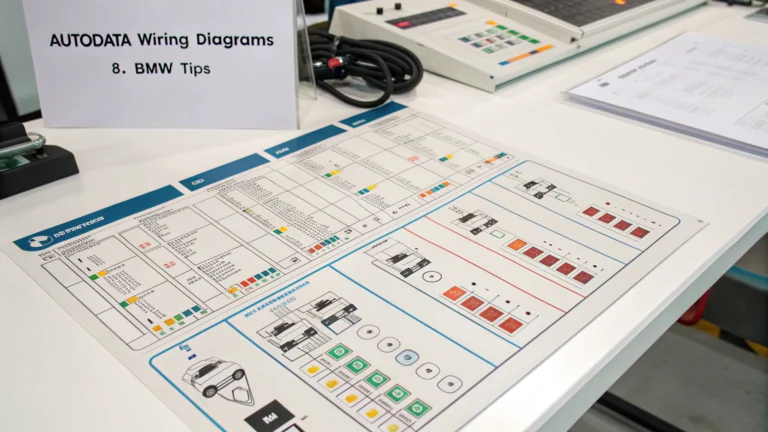
Pull technical diagrams and schematics directly through your AutoFixData interface. Wiring diagrams and technical schematics from Autodata API precisely illustrate harness layouts, fuse box locations, ECU pin-outs, and component placement.
(Visual suggestion: Example of a sample wiring diagram through Autodata API integration.)
Step 5: Implement Repair Guidance & OEM-Specific Specifications
Using Autodata API-supported repair procedures ensures manufacturer-specific accuracy. From correct torque values to fluid capacities, component replacement guidelines, alignment parameters, and ECU reprogramming guidance, the API connects you reliably each time.
Step 6: Record Maintenance & Support Documentation
Easily track completed jobs with automated documentation integrated seamlessly via API connectivity, helping you improve record-keeping and vehicle maintenance history management.
Common Mistakes to Avoid
While the Autodata API minimizes guesswork, avoiding common missteps remains crucial:
- Failing to update API-linked workshop tools regularly – Always ensure your software’s API access remains up to date.
- Ignoring VIN-specific vehicle selection – Always utilize VIN decoding for the most accurate diagnostics.
- Misinterpretation of diagnostic data – Confirm understanding using Autodata notes, bulletins, and diagnostics details; never assume interpretation.
- Skipping OEM procedures outlined – Rely on the OEM manufacturer’s guidance through Autodata API’s integrated procedures rather than short-cutting repairs.
Advanced Techniques: Elevate Your Diagnostics
Expert mechanics understand advanced features to elevate diagnostics even further:
- Data-driven Predictive Maintenance: Utilize aggregated Autodata insights coupled with advanced analytics tools for proactive customer vehicle maintenance schedules.
- Training & Onboarding: Leverage your AutoFixData diagnostic software integration to onboard new technicians quickly, utilizing guided diagnostics provided by API data.
- Integration of Additional Data Streams: Connect data from multiple API platforms, including Autodata, HaynesPro, and AllData, within AutoFixData’s multifaceted diagnostic approach.
Tools and Resources Needed
For complete utilization of the Autodata API effectively, ensure your shop is equipped with:
- Compatible diagnostic scan tools (OBD-II and advanced Multi-brand scanners)
- Internet-connected workshop computer or tablet for API integration
- AutoFixData subscription allowing seamless access to Autodata, HaynesPro, and AllData information platforms
- Access to technical training and support provided by AutoFixData for optimal API use
Real-World Application: Case Study
Consider a garage that integrated the Autodata API via AutoFixData. They faced intermittent performance issues and multiple DTCs on a 2017 Audi A6. Via quick API access, technicians decoded the VIN, retrieved specific wiring diagrams, TSBs (Technical Service Bulletins), and pinpointed a hidden wiring harness corrosion identified in OEM guidance—all within minutes rather than hours. Integrating Autodata API resolved a costly, recurring complaint efficiently, saving valuable diagnostic time.
Conclusion
Integrating the Autodata API into your diagnostic workflow ensures rapid, precise, and profitable solutions for automotive professionals. Using AutoFixData’s unified approach—AllData, AutoData, and HaynesPro simplified into a user-friendly platform—garages can drastically improve efficiency, accuracy, and profitability.
Ready to enhance your automotive diagnostics today? Discover our simple, affordable offerings at AutoFixData Pricing and join thousands of automotive businesses that trust us daily.
FAQs About the Autodata API
1. Is the Autodata API compatible with all scan tools?
The API is software-driven; as long as your diagnostic tool can send data to integrated software platforms (provided by AutoFixData), compatibility is effortless.
2. Does the Autodata API support commercial and heavy vehicles as well?
Yes, Autodata API covers both passenger and select commercial vehicles, covering European, Asian, and American manufacturers extensively.
3. Do I need technical expertise to use the Autodata API effectively?
Basic computer literacy is sufficient; technical guidance and training provided by AutoFixData make usage straightforward even for beginners.
4. What if I encounter difficulties accessing Autodata API data?
AutoFixData provides comprehensive technical support and reliable uptime, ensuring minimal interruptions to your workflow.
5. How often is vehicle diagnostic data updated via Autodata API?
Vehicle data packages are updated continuously to ensure technicians access current OEM-specific information and industry standards.
Ready to supercharge your diagnostics workflow? Explore AutoFixData Plans Today!