Daily Repair Tasks Simplified with Autodata
Introduction
Working in an automotive repair shop means you frequently face complex diagnostic challenges. Every mechanic knows that quick and accurate solutions hinge on having reliable diagnostic resources. One common obstacle is accessing accurate, vehicle-specific repair data quickly when confronted with challenging fault codes, wiring issues, or intricate mechanical repairs. Mechanics often feel overwhelmed by the sheer amount of data spread across multiple sources. Thankfully, integrating Autodata use cases into daily operations significantly streamlines diagnosis and repairs. AutoFixData provides instant access to trusted diagnostic platforms such as AllData, Autodata, and HaynesPro, consolidating all essential information into one user-friendly tool.
In this blog article, we’ll dive deep into common repair tasks mechanics face, highlight Autodata use cases that help resolve these challenges, and detail how AutoFixData leverages industry-leading tools to optimize your daily repair workflow.
Problem Identification
As an automotive technician or garage owner, you're constantly under pressure to solve problems quickly and efficiently. Let's examine some of the frequent diagnostic challenges mechanics typically encounter:
- Handling intermittent electrical faults that are challenging to replicate
- Diagnosing obscure engine trouble codes that manufacturer service manuals inadequately cover
- Confusing and sometimes ambiguous wiring diagrams that lead to lost repairs and increased downtime
- Incomplete procedural instructions resulting in incorrect component installations or adjustments
According to industry surveys, mechanics often spend more than 40% of their working hours diagnosing vehicle issues and searching for reliable repair information. This lost productivity substantially impacts your bottom line, customer satisfaction, and shop efficiency.
These issues emphasize why reliable and streamlined diagnostic solutions—the heart of Autodata use cases—are crucial.
Technical Background
Before exploring Autodata’s versatile diagnostic application, it’s essential to understand some foundational automotive diagnostic principles clearly:
Vehicle Systems and Module Functionality
Modern cars employ multiple specialized control units (ECUs) for different vehicle operations (engine, ABS, air-conditioning, body electronics, etc.). Each control module communicates via electronic signals; diagnostic trouble codes (DTCs) generated by these ECUs give clues to various faults.
Onboard Diagnostics (OBD-II)
Understanding the correct interpretation of DTCs is critical. OBD-II provides standardized diagnostic pathways but works alongside manufacturer-specific diagnostic information to offer comprehensive diagnostic accuracy.
Wiring Diagrams and Schematic Interpretations
Electrical diagnostics heavily depend on accurate wiring diagrams. Misinterpreting these diagrams may lead to incorrect diagnoses, wasted time, and potential component damage.
Clearly, accessing and interpreting correct diagnostic information is an essential step that determines the quality and efficiency of your automotive repair.
Solution Overview
This is precisely where Autodata use cases prove their worth. Industry-leading diagnostic resources available at AutoFixData, such as Autodata, AllData, and HaynesPro, streamline repairs by providing accurate, easy-to-follow diagrams, fault descriptions, wiring information, known faults, and step-by-step procedures.
Some standout features offered by these diagnostic platforms include:
- Comprehensive, vehicle-specific diagnostic trouble code reports
- Interactive wiring diagrams simplifying electrical diagnoses
- Manufacturer-recommended maintenance procedures and repair steps
- Technical Service Bulletins (TSBs) outlining known faults and resolutions
- Labor times and repair estimations for effective customer communication and invoicing
Step-by-Step Process: Leveraging Autodata Use Cases Effectively
Let's break down a typical diagnostic repair scenario step-by-step, applying Autodata use cases for rapid, reliable problem-solving.
Step 1: Identify the Vehicle and Retrieve Relevant Data
- Use AutoFixData to quickly pull up the vehicle by make, model, engine code, or VIN.
- Immediately access relevant Autodata use cases and diagnostic data such as fault codes, wiring diagrams, and TSBs.
(Suggestion: A screenshot showing vehicle selection on AutoFixData)
Step 2: Diagnose Fault Codes and Symptoms
- Enter or scan displayed diagnostic trouble codes (DTCs).
- Autodata provides a comprehensive explanation, typical symptoms, and known fixes directly linked to the selected DTC.
(Visual suggestion: Image of a diagnostic trouble code description screen)
Step 3: Check Wiring Diagrams and Component Locations
- Refer to interactive wiring diagrams and component locations to trace suspected electrical faults clearly.
- Autodata wiring diagrams utilize clear, color-coded schemes, minimizing confusion and diagnostic errors.
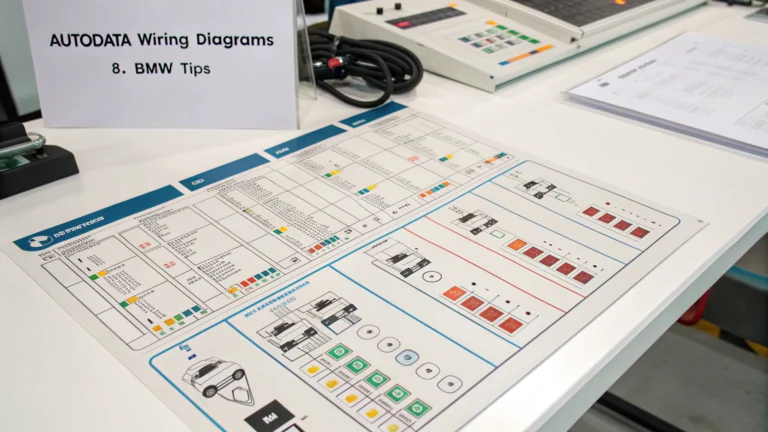
(Insert a visual snapshot of a wiring schematic diagram here.)
Step 4: Follow Manufacturer-Guided Maintenance and Repair Instructions
- Precise Autodata-driven repair instructions provide step-by-step guidance, specific torque values, tightening sequences, and special precautions.
- Ensure a correct and efficient repair by referring to manufacturer-specific procedures.
Step 5: Verify and Document Repairs
- After repairs, use your diagnostic scanner to clear codes, run diagnostic tests, and confirm proper repair of the vehicle.
- Document repairs clearly for future reference and good customer communication.
Common Mistakes to Avoid
Using diagnostic platforms incorrectly may cause delays or incorrect diagnostics. Avoid these common pitfalls:
- Neglecting the initial trouble code verification or jumping straight to parts replacement without proper diagnosis.
- Ignoring known fixes and Technical Service Bulletins (TSBs) provided by Autodata.
- Misinterpreting wiring diagram schematics, leading to faulty electrical repairs.
- Not updating your diagnostic database or relying on outdated diagnostic software.
By staying vigilant of these common mistakes, you optimize the benefits of Autodata use cases effectively.
Advanced Techniques
Experienced automotive technicians apply some advanced techniques when using Autodata solutions:
- Cross-System Analysis: Use Autodata to cross-reference symptoms with multiple affected systems for verifying complex failures (CAN-bus issues, multi-module fault scenarios).
- Multi-Stage Diagnostic Strategy: Establish organized diagnostic flowcharts based on Autodata diagnostics, avoiding unnecessary component swaps.
- Continuous Professional Education (CPE): Staying updated by leveraging Autodata’s abundant learning and training resources regularly.
Tools and Resources Needed
To successfully apply Autodata use cases in real-world scenarios, ensure you have the following tools in your workshop:
- OBD-II compatible advanced automotive diagnostic scanner (Bosch KTS, Snap-On, Autel MaxiSys series, etc.)
- Reliable workshop computer (and potentially tablet) with internet access for live AutoFixData access.
- Automotive multimeter and suitable test leads for circuit tests.
- Oscilloscope for more complex waveform diagnostics of sensors, actuators, or networks (CAN, LIN bus)
Autodata excels with diagnostic integration, facilitating quick problem-solving regardless of complexities.
Real-World Application
In one recent case, an automotive technician faced an intermittent engine stalling and codes related to poor throttle response on a BMW 3-series. Initial tests were inconclusive. Leveraging Autodata use cases on AutoFixData revealed a detailed TSB highlighting a worn wiring harness causing intermittent throttle position signals. Following the step-by-step procedures provided, mechanics quickly identified damaged wires, performed the recommended wiring repair, and resolved the issue permanently.
Conclusion
Autodata use cases simplify automotive diagnostics, enabling quick, accurate and reliable vehicle repair tasks. By leveraging comprehensive diagnostic resources such as Autodata, AllData, and HaynesPro within the powerful AutoFixData platform, mechanics confidently confront and solve diverse mechanical and electrical challenges.
Transform your automotive shop experience with comprehensive data access and streamlined repair procedures. Step away from wasted hours and resource inefficiencies. Start optimizing your diagnostic process today by accessing AutoFixData's reliable diagnostic solutions.
Discover More: Visit Our Pricing Page and Streamline your Shop’s Workflow Today
FAQs
1. What are the primary benefits of integrating Autodata use cases into our daily workflow?
Integration leads to faster diagnostics, improved repair accuracy, reduced downtime, greater customer satisfaction, and more profitable shop management.
2. Do Autodata diagnostic solutions cover all vehicle brands and models?
Yes, Autodata documentation spans extensive global coverage for most vehicle makes and models—both European and international vehicles.
3. Can beginner technicians easily interpret diagnostic data from Autodata?
Yes, Autodata provides clear, intuitive interpretations of complex diagnostic information—ideal for both seasoned mechanics and less-experienced technicians alike.
4. How often is diagnostic data updated in platforms such as Autodata and AllData?
Diagnostic platforms accessed via AutoFixData receive regular updates—often monthly—to ensure users have the latest vehicle data, TSBs, and best-practice diagnostic information.
5. Should our workshop subscription include access to multiple diagnostic platforms or just one?
Access to multiple diagnostic resources like Autodata, AllData, and HaynesPro ensures comprehensive coverage, allowing technicians to cross-reference information and diagnose even challenging automotive problems thoroughly.