Utilizing Autodata’s VIN Lookup Feature
Introduction
Every mechanic or automotive technician has spent countless hours facing a common yet frustrating challenge: correctly identifying vehicle specifications, service bulletins, repair data, or diagnosing obscure faults. Misidentifying a vehicle can lead to ordering the wrong parts, performing incorrect repairs, and ultimately wasting valuable time and money. Fortunately, diagnostic platforms like Autodata have streamlined vehicle identification processes through highly effective VIN Lookup features. Leveraging Autodata VIN functionality, mechanics can rapidly and accurately access detailed vehicle information, significantly reducing errors and improving workshop productivity. At AutoFixData, we understand the critical role accurate vehicle identification plays in quality automotive repair and service, offering seamless integration of Autodata’s VIN Lookup tool into our suite of professional diagnostic solutions.
In this comprehensive guide, we’ll explore exactly how you, as a professional mechanic or enthusiast, can utilize the autodata VIN feature to streamline your diagnostic processes, enhance accuracy, and achieve more profitable results from your automotive repairs.
Problem Identification
Incorrect vehicle identification remains one of the most frequent initial mistakes in automotive diagnostics and repairs. Statistically, more than 20% of automotive repair delays stem from improper or incomplete vehicle identification performed at the initial diagnosis stage. Considering the modern complex nature of vehicle systems, a simple, preventable error in vehicle identification can mean significant setbacks.
For example, ordering incorrect brake pads, suspension parts, timing belts, or electronic control modules due to misreading or misinterpretation of VIN numbers can result in costly work delays and diminished customer satisfaction levels. Additionally, missing critical vehicle health bulletins, recalls, or technical service releases could pose significant safety risks.
Technical Background
A Vehicle Identification Number (VIN) is a 17-character alphanumeric code that uniquely identifies every automobile manufactured since 1981. Located on the dashboard, door jambs, firewall plates, or visible through the windshield, the VIN provides essential details including manufacturer’s identity, vehicle specifications, model year, assembly plant, engine type, and more.
Manufacturers standardized VIN coding under ISO 3779, allowing easy identification of accurate technical specifications, recalls, and bulletins. Each VIN is structured into three key sections:
- World Manufacturer Identifier (WMI): First three characters identifying county and vehicle manufacturer.
- Vehicle Descriptor Section (VDS): Characters 4-9 represent vehicle details (engine type, body style, transmission).
- Vehicle Identifier Section (VIS): Characters 10-17 uniquely identify the specific vehicle manufacturing data (year, assembly plant, serial number).
Understanding VIN structure allows professionals direct access to critical vehicle information within diagnostic software databases like Autodata, AllData, and HaynesPro.
Solution Overview
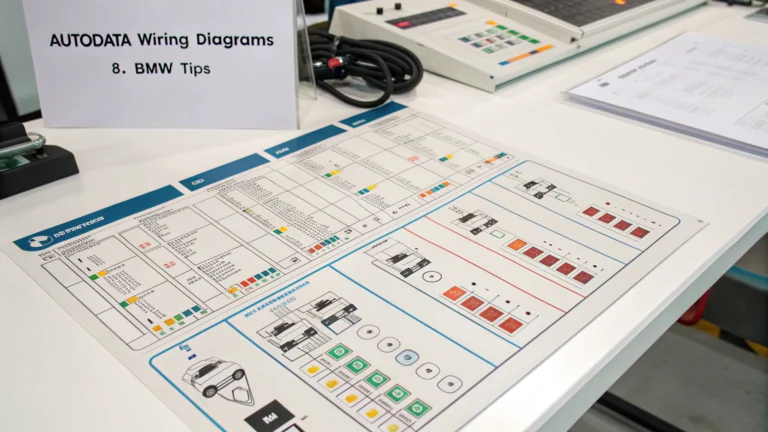
Diagnostic information providers such as Autodata, accessible via AutoFixData.com, utilize the VIN Lookup tool to simplify and streamline professional vehicle identification processes. Autodata VIN decoding significantly reduces diagnostic guesswork by providing instant access to exact manufacturer specifications, service data, component diagrams, wiring schematics, known faults, repair procedures, and technical bulletins directly tied to the specific vehicle.
When you enter a VIN within Autodata’s platform (available through AutoFixData subscriptions), the software automatically cross-references thousands of detailed technical documents, pinpointing exactly what mechanics need. Autodata’s VIN search capability ensures reliable technical accuracy and greatly reduces the chance of mechanical errors.
Step-by-Step Process
To fully leverage the Autodata VIN Lookup tool, technicians can follow these clear steps:
Step 1: Locating and Recording the VIN
Carefully locate the VIN. Most commonly, find it through the windshield base, inside the driver’s side door jamb, or stamped under the hood on identification plates. Record the VIN clearly and carefully to maintain accuracy.
Step 2: Access Autodata through AutoFixData Platform
Log into your AutoFixData subscription portal and navigate to the integrated Autodata platform. Using integrated diagnostic databases ensures consistency and minimizes errors.
Step 3: Enter or Scan the VIN
Enter the full 17-digit VIN manually or, if equipped, scan using a barcode scanner or mobile scanning app to eliminate manual-entry errors.
Step 4: Confirm and Validate Vehicle Selection
Once submitted, Autodata VIN decoding immediately returns comprehensive data on your specific vehicle. Verify displayed details carefully, including model year, engine configuration, trim package, and transmission type.
Step 5: Access Manufacturer Technical Information
Autodata links accurate VIN decoded data to detailed OEM-level information: wiring schematics, torque values, fluid capacities, electronic troubleshooting guides, and OEM recall or release bulletins. Use these dependable insights throughout repair procedures.
Step 6: Apply Information to Diagnostic & Repair Processes
With accurate VIN-derived data, confidently order precise parts, perform recommended OEM procedures, verify diagnostic faults, and mitigate guesswork. This accuracy reduces workshop costs, boosts efficiency, and increases customer satisfaction levels.
Tip from Experienced Mechanics:
Always confirm key details such as engine code or trim-specific parts availability after using a VIN lookup tool. While accurate, double-checking crucial components ensures optimal accuracy.
Common Mistakes to Avoid
When utilizing the autodata VIN feature, mechanics should watch out for and steer clear of these common pitfalls:
- Incorrectly Inputting VIN Digits: Always cross-check and double-verify your VIN entry to prevent basic data-entry errors.
- Ignoring Critical Manufacturer Updates/Recalls: Utilize VIN-specific bulletins and recall notifications provided by Autodata to ensure complete repairs.
- Not Validating VIN Data: Always verify returned data matches the physical vehicle to identify potential database discrepancies or rare manufacturer data-entry errors.
Advanced Techniques
Seasoned mechanics can obtain even greater productivity with Autodata’s advanced VIN features:
- Batch VIN Checks for Fleet Analysis: Conduct simultaneous VIN lookups to efficiently handle larger fleet operations.
- Mobile VIN Scanning Integration: Equip your technicians with handheld scanners or mobile apps linked to Autodata via AutoFixData subscriptions. Instant mobile access to specifications saves additional time.
- Integration with Advanced Diagnostic Systems: Connect Autodata VIN-decoding with OBD scanners and workshop diagnostic equipment to enhance the overall diagnostic workflow.
Tools and Resources Needed
To make the most of the autodata VIN lookup feature, workshops require:
- Professional subscriptions to diagnostic data providers like Autodata (via AutoFixData)
- Barcode scanners/mobile scanning apps
- Internet-enabled diagnostic devices
- Workshop diagnostic equipment integrated with Autodata
The efficiency, accuracy, and OEM-level detail provided by Autodata VIN supports workshop productivity significantly better than basic manual lookups or generalized specification databases.
Real-World Application
Let’s review a practical scenario: A high-volume automotive service garage receives a late-model VW Golf with subtle fueling and idle issues. Seeing no obvious label indicating engine code, technicians use the Autodata VIN Lookup feature. With a quick VIN entry into AutoFixData’s Autodata integration, they immediately identify exact OEM data covering correct spark plug types, ignition coil specifications, known throttle-body service bulletins, and software reprogramming advisories. Armed with complete OEM-specific data, they rapidly perform precise diagnostics and repairs without ambiguity.
Conclusion
Effectively utilizing the autodata VIN lookup feature offers immediate benefits in workshop efficiency, significant reductions in diagnostic errors, enhanced customer satisfaction, and overall improved profitability. AutoFixData provides seamless access to trusted diagnostic platforms like Autodata, AllData, and HaynesPro, ensuring automotive professionals have reliable tools for outstanding performance.
Leverage this powerful VIN decoding capability today, maximizing diagnostic accuracy and reducing costly errors.
Explore AutoFixData Subscription Options Here
FAQs
Q1: Can Autodata VIN lookups decode vehicles from all manufacturers?
Yes, Autodata’s VIN database supports decoding virtually all manufacturer VINs, covering North American, European, and Asian makes extensively.
Q2: Is Autodata VIN decoding updated regularly?
Absolutely. Autodata continually updates its VIN decoding database and manufacturer technical data to reflect current and relevant OEM information.
Q3: Can I perform VIN lookups on older classic vehicles?
Typically, VIN decoding accuracy applies best to vehicles built after the standardization year of 1981. For older vehicles, some limited data may be available.
Q4: Does VIN lookup include OEM recall information?
Yes. Autodata’s VIN decoding includes relevant OEM manufacturer bulletins and recall notices, enhancing diagnostic accuracy and safety.
Q5: Will Autodata’s VIN tool work with mobile devices via AutoFixData platform?
Definitely. Autodata’s VIN lookup integrates seamlessly with mobile devices, greatly increasing efficiency during diagnosis and repair.